Matter or a Proprietary System: Is Switching Worth It?
Matter or a proprietary smart home system? Pros and limits of both approaches, cloud vs local control, and a decision guide for your home.
By Tobias ·· 7 min read
Matter or a proprietary system is a question that comes up before almost every larger smart home purchase. Proprietary systems offer an app, a coordinated ecosystem and often special features of their own. Matter provides an open standard that connects devices from different brands and can enable local control. Both approaches have their justification. Here you will learn the advantages and limits of each, when a switch makes sense, and when you are better off staying with your existing system.
Matter or a proprietary system: the short answer
Matter is an open standard that works across manufacturers. Proprietary systems, by contrast, are tailored to the products of one provider. If you want to combine many brands, Matter usually works well. If you need a specific special feature or are happy with an ecosystem, you are often better off staying with it. Many devices can also be used both ways: through the manufacturer’s app and through Matter.
What proprietary systems are
A proprietary system usually consists of three parts: devices from the manufacturer, an app and often a service on the internet. This brings advantages:
- Coordinated interplay: Devices and app are tailored to each other.
- Special features: Manufacturers can offer functions that a shared standard does not cover.
- Uniform operation: One app for everything makes getting started easier.
The downside is dependence on the provider. Updates, functions and services follow the provider’s decisions. In addition, functions can be restricted if the online service or the internet connection fails.
What Matter offers
Matter is designed as a shared standard. Devices from different manufacturers speak the same language, and this brings clear benefits:
- Across manufacturers: You can combine devices from several brands in one system.
- Local control: Commands can stay in the home, provided the control system implements this.
- Several systems: With multi-admin, a device can be used in more than one system. I explain the details in the article Matter multi-admin explained.
- Comparable device types: Plugs, sensors or lamps follow fixed definitions.
The limits of Matter
The open standard also has limits you should know about:
- Special features are often missing: Not every peculiarity of a manufacturer is mapped through Matter. This depends on the device and the manufacturer.
- The controller has a say: How well Matter works depends on which control system you use.
- New features do not arrive everywhere at the same speed: Proprietary systems can introduce innovations first.
The important distinction here is between the standard and its implementation. Matter defines what a device can fundamentally do. How a control system displays these functions, links them and makes them usable in automations is decided by the software in question. Two systems can therefore implement the same Matter version with different quality.
The limits of proprietary systems
Proprietary systems also have weaknesses:
- Tied to one provider: A device usually belongs to a particular ecosystem.
- Dependence on the service: If the manufacturer’s service or the internet fails, functions can be restricted.
- Difficult to combine: Devices from different brands can only be brought together with effort.
The comparison in a table
| Criterion | Matter | Proprietary system |
|---|---|---|
| Device choice | Across manufacturers | Mostly products of one provider |
| Control | Local where the controller allows it | Often via the manufacturer’s service and cloud |
| Special features | Only as far as the standard defines them | Manufacturer-specific |
| Switching systems | Possible with multi-admin | Usually tied to the system |
| Updates | Standard plus updates from the manufacturer | Determined by the manufacturer |
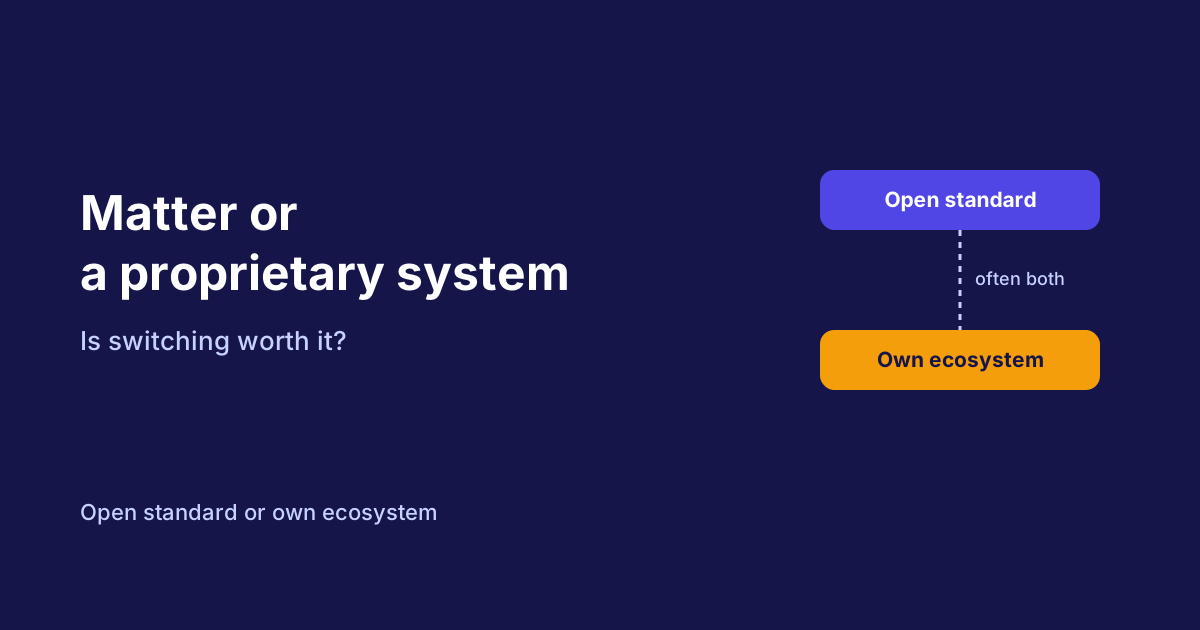
Decision guide as a diagram
This question often helps with the classification right away:
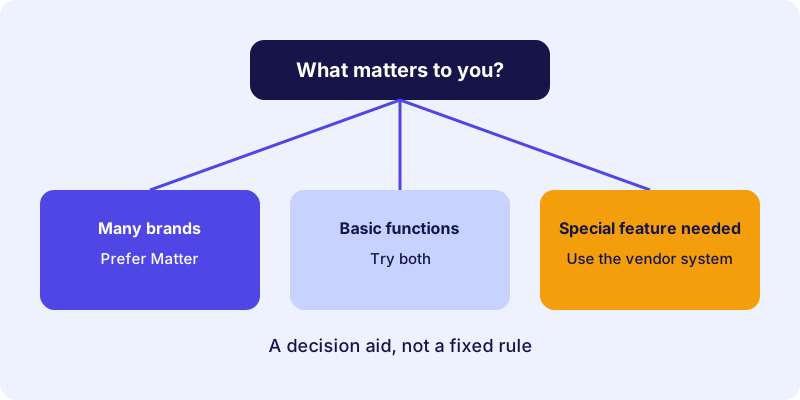
If vendor independence matters to you, Matter is the obvious choice. If you need a particular function that only the proprietary system offers, that route remains sensible. For simple basic functions, it is worth testing both approaches.
When switching makes sense
A switch to Matter can make sense when:
- you are buying new devices anyway and make sure they support Matter,
- you want to control devices from several brands in one system,
- you want to become less dependent on a single provider,
- you value local control and your control system supports it.
When you should stay with your proprietary system
The existing system is often the better choice when:
- you use special features that Matter does not map,
- your system runs reliably and a conversion would bring no real benefit,
- you are happy with the app and how the devices work together.
A proprietary system is not a dead end. Many providers add Matter gradually, and some devices can still be used in parallel. Even so, check regularly whether the feature set of your system has changed before you make larger investments.
Devices with an app and Matter: using both
Many devices offer Matter alongside the manufacturer’s app. In that case you do not have to choose and can use both. Check the manual to see whether Matter can be activated and which functions are available through it. The article Setting up a Matter device explains setup via Matter.
Specific notes on individual systems can be found in the articles Matter with Apple Home, Matter with Google Home, Matter with Alexa and Matter with SmartThings. They cover the particularities of each platform.
Checklist before you decide
Before you commit, clarify these points:
- Which devices do you need? Write down the list with device type and desired brand.
- Does your system support Matter? Without a suitable controller, even the best Matter device is of little use.
- Which special features are important to you? Check whether they are available through Matter or only in the manufacturer’s app.
- How important is local control? Clarify which services still need an internet connection, such as voice commands or remote access.
- What is your long-term plan? Consider whether you want to use the same brand in a few years or whether a change of system is conceivable.
Once you can answer these questions, the decision usually becomes easier. Often it turns out that a mix of Matter devices and manufacturer products is the most sensible solution.
Conclusion: open or integrated?
Matter or a proprietary system is not a question of belief. Matter offers openness, vendor independence and the possibility of local control. Proprietary systems score with integration, special features and a uniform app. What matters is what you need. If you are starting new, Matter is worth considering as a foundation. If your existing system works well, you do not have to replace it. The device directory lists certified Matter devices, and you can compare suitable products there.
Frequently asked questions
Is Matter or a proprietary system better?
That depends on your goal. Matter is open and works across manufacturers. Proprietary systems often offer special features and a coordinated app. Both have their justification.
Can I use a device in the manufacturer app and in Matter at the same time?
Often yes. Many devices support Matter in addition to the manufacturer app. Whether this applies to your device and how the setup works is described in the manual.
Do I lose functions when I switch to Matter?
That can happen. Not every special feature of a manufacturer is mapped through Matter. Check in advance which functions are important to you.
Is Matter always controllable locally?
Not automatically. Local control depends on how your control system implements Matter. The system documentation helps you classify this.
Can I switch between systems later?
With Matter this is often easier, because a device with multi-admin can be used in several systems. With proprietary systems, switching is usually more involved.