Series: Matter from A to Z · Part 1 of 8
What Is Matter? The Smart Home Standard Explained Simply
What is Matter smart home? The open standard explained: cross-brand, local and certified. The basics, simply and practically.
By Tobias ·· 7 min read
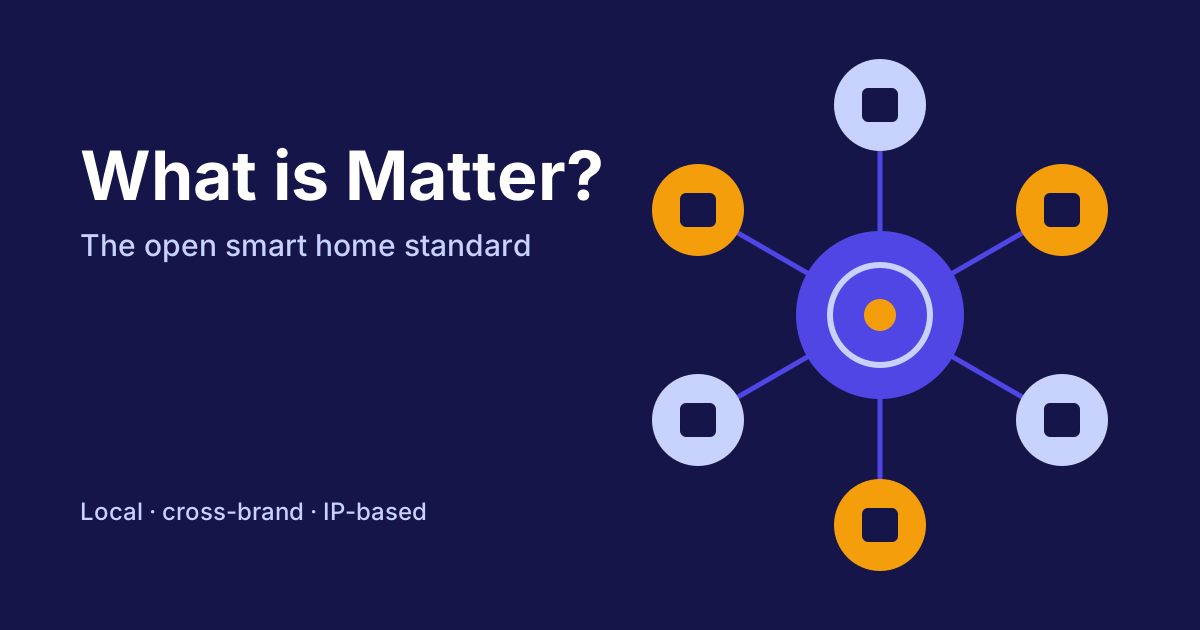
If you're wondering what Matter smart home really means, you're not alone. The name now appears on lamps, plugs, sensors and locks, often without any explanation. In short, Matter is an open smart home standard that lets devices from different manufacturers speak the same language. You can use a Matter device in many systems without being tied to a single brand. Here you'll learn how Matter works, what advantages it brings and what to look for when buying.
What is Matter smart home in one sentence?
Matter is a cross-manufacturer, locally operating smart home standard built on IP networks. Devices that support Matter understand each other and every compatible control system. The goal: fewer isolated solutions and more freedom of choice.
Where Matter comes from
Matter is developed and maintained by the Connectivity Standards Alliance (CSA). The organization was previously known as the Zigbee Alliance. Behind Matter stand numerous manufacturers from the industry, including providers of lights, sensors, plugs and smart home platforms. Together they defined how devices are found, set up and controlled.
The three basic ideas behind Matter
Matter can be described by three characteristics you notice in everyday use.
Cross-manufacturer
Matter is a shared standard, not the product of a single provider. A device with Matter support can be integrated into any Matter-compatible system. This is the main reason Matter differs from proprietary solutions.
Local
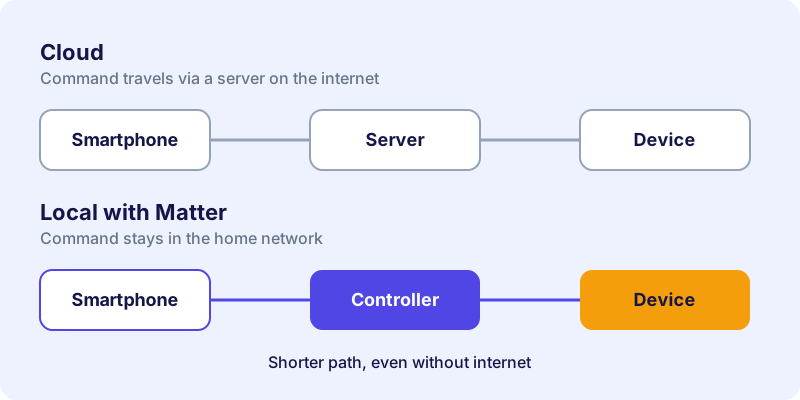
With Matter, commands travel directly within your home network from the control system to the device. For local control you don't need a connection to a server on the internet. Voice assistants, remote access or notifications can still use cloud services, however.
Built on IP
Matter relies on the Internet Protocol, meaning the same kind of addressing your network already uses. Devices can be connected via Wi-Fi, Ethernet or Thread. You'll find out which radio technology is behind this in the article Thread, Wi-Fi or Ethernet.
How Matter works in everyday life
Setting up a Matter device usually runs through the app of your control system. The device is first found via Bluetooth LE and then connected to the network. This process is called commissioning. Afterwards the device and the controller communicate over your home network. The control hub, the system in which you set up the device, is called the controller.
An example of a control hub with Matter support:
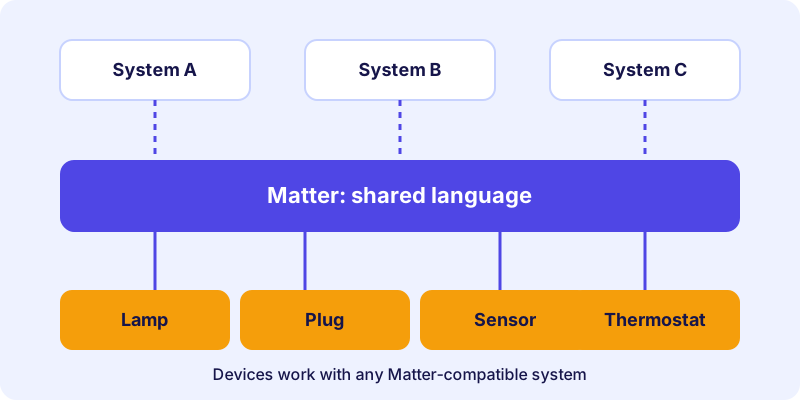
The diagram shows the principle: several systems use the same Matter layer, and the same devices sit underneath. If you switch your control system, you usually don't have to buy the devices again. You only need to add them to the new system.
An everyday example
Imagine you buy a Matter plug and a motion sensor from two different manufacturers. Both devices register with your Matter-compatible control hub. There you create a rule: when the motion sensor in the hallway is triggered, the plug switches on the reading lamp. You have combined two brands without any detour via an additional bridge.
Without a common standard, you would in many cases have had to choose devices from a single brand so that everything works together. Exactly this dependency is what Matter aims to reduce.
What you need to get started
To get started you need three things: a control system with Matter support, a smartphone with the matching app, and devices that support Matter. A stable Wi-Fi connection also helps, because many devices rely on your home network in the background. Whether you also need a Thread border router depends on your devices. The basics are explained in the follow-up articles of this series.
Local instead of cloud
Many manufacturer-specific solutions send commands through a server on the internet, even when you only want to switch on the light in the living room. With Matter, the command stays in your house. This brings three advantages: shorter response times, less dependence on the internet and more control over your data.
Certification: how to recognize a genuine Matter device
Matter devices must go through certification. The data is published in the Distributed Compliance Ledger (DCL) of the CSA, a public database. There you can view manufacturers, product IDs and certification data. The device directory on matter.tips is also based on this information.
On the packaging you will usually find a note that the device supports Matter. A look at the data sheet also shows which radio technology it uses. An example of a Matter device with Thread and Bluetooth LE is this lamp:
Matter and multi-admin
One of the most practical features of Matter is the ability to use a device in several systems at the same time. This feature is called multi-admin. How it works and what you should keep in mind is explained in the article Matter Multi-Admin: One Device, Several Smart Home Systems.
Matter compared to proprietary systems
Matter is not automatically better than every manufacturer solution. It does, however, have different priorities. This table helps with the comparison:
| Feature | Matter | Proprietary system |
|---|---|---|
| Devices from different brands | Intended | Usually only within the manufacturer's own ecosystem |
| Control in the home network | Foundation of the standard | Depends on the system |
| Range of functions | Common core of functions | Often with additional manufacturer features |
| Setup | Via the app of the chosen system | Usually via a manufacturer app |
Limits of Matter
Matter is a standard that evolves over time. Not every Matter device supports every function, and not every control system implements everything in the same way. For lamps and plugs the basic function is usually reliable. For more complex devices such as cameras or locks, it's worth checking the product information. Software updates also depend on the manufacturer and the system.
Conclusion: how to approach buying
Matter makes sense if you want to combine devices from different brands or keep the option of switching your control system later. When buying, look for the Matter note, check the supported radio technology in the data sheet, and use the device directory to see which models are certified. If you want to dive deeper, read the article about Thread, Wi-Fi and Ethernet next.
Frequently asked questions
Is Matter the same as Thread?
No. Matter is the shared language of the devices. Thread is one of several radio technologies through which Matter devices can be connected to the network.
Do I need a specific smart home system for Matter?
You need a system that supports Matter, for example a control hub or a hub-based system. Which system you choose is up to you.
Does Matter work without an internet connection?
Local control over your home network works without internet. Remote access, certain voice commands and notifications when you're away, however, require a connection to the outside.
Are all smart home devices compatible with Matter?
No. Only devices with Matter support can be used within the Matter standard. Older devices that use other protocols often only work through a bridge or within the manufacturer's own system.
Do I have to replace my existing devices right away?
No. You can introduce Matter step by step and choose new devices with Matter support on purpose. Existing devices stay in their system until you replace them or connect them through a bridge.